
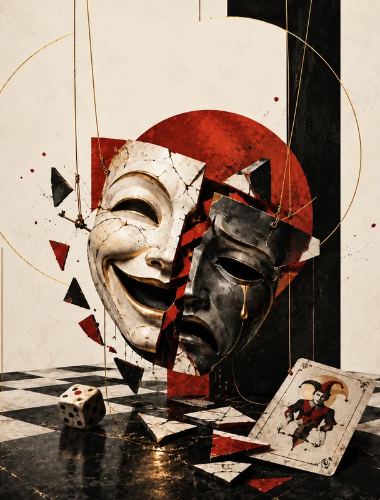
Hāsya is the second Rasa in my Navras series. In the Nāṭyaśāstra, it is associated with hāsa; laughter, humour, and the comic, arising from satire, the absurd, the incongruous, the unexpected, and the exaggerated.
But when I began writing this poem, one question kept returning to me: The world we experience through our senses is governed by impermanence. As mortals, isn’t our audacity to take ourselves so seriously the greatest Hāsya of all?
Our logical mind is conditioned to make structured plans with meticulous precision. We anticipate outcomes, demand certainty, seek control, and crave absolute assurance that our carefully constructed plans will unfold as expected, even within an unpredictable existence.
There’s a very famous adage: “Man proposes, God disposes.” And yet it is part of human nature to cling to what we call “mine”; to defend our beliefs, deploy stratagems in our pursuit of success, and attempt to make the world conform to the narrative we have constructed about ourselves.
However, that doesn’t mean that one must stop believing, creating, building, and envisioning a future. The pain and agony arise only when things don’t unfold the way we had anticipated or imagined, when reality refuses to conform to the vision that we have so painstakingly constructed.
It’s within this disruption, the divergence between what we anticipate and what actually unfolds, that my interpretation of Hāsya emerges: the absurdity of living like an immortal in a mortal dimension.
Through the poem, I’ve tried to explore our uneasy, transient relationship with expectation, control, possession, ego, and the illusory world we construct for ourselves. Perhaps Hāsya begins, amidst all our seriousness, when we suddenly recognise the absurdity of being human.
View this post on Instagram