
Patriarchy lies in the perverse entitlement of so-called ‘morally upright’ men, who deem it their prerogative to trample upon women’s rights under the guise of authority. These men, often positioned as custodians of tradition and virtue, are complicit in a culture that legitimises the subjugation of women as a natural or inherited entitlement, thereby perpetuating female subservience – crafted meticulously to gratify their own whims. What emerges is a deeply entrenched, misogynistic order in which women are reduced to vessels: bodies commodified and instrumentalised solely to appease male desire, while their own needs, aspirations, autonomy, and personhood are systematically pulverised – dismissed as collateral in a world calibrated to uphold patriarchal dominance.
What of a woman’s desires, needs, and ambitions? Does she not possess an equal claim to her rights within the institution of marriage and the realm of decision–making? For how long must women endure humiliation at the hands of their husbands simply because they are unable to bear a male child? Why are women persistently treated as burdens – reduced to mere instruments of service within a familial structure that privileges male authority?
Is she not entitled to dream, to aspire, to chart the course of her own life? Can it ever be morally defensible for a husband to cast aside his wife in favour of another, merely because he is religiously permitted to marry multiple times? Has anyone paused to consider the psychological and physical violence she might endure – violence that is too often cloaked in the language of religious doctrine or cultural expectation? Where, in this deeply skewed paradigm, is the woman’s voice – her suffering, her consent, her truth?
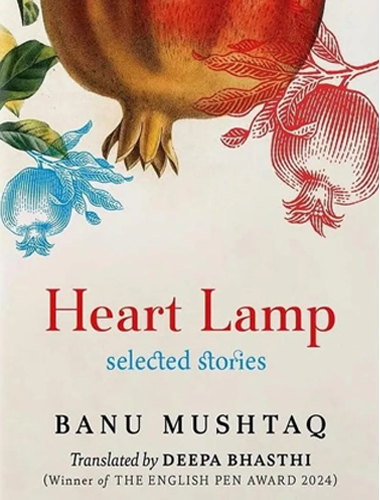
These were some of the questions that arose in my mind while reading the formidable text ‘HEART LAMP’ authored by Banu Mushtaq and masterfully translated by Deepa Bhasthi. What renders Heart Lamp monumental is the sheer magnitude and gravitas of its content. With a voice that is both unflinching and deeply affecting, the text compels the reader to awaken from complacency and confront the unsettling truths of women’s lived realities. Through a constellation of twelve short stories – each intricately threaded with a shared consciousness, whether in the literal glow of a lamp or the metaphorical flicker of a woman’s awakening – these standalone narratives offer a kaleidoscopic view into the lives of Muslim women, as they negotiate autonomy within heavily gendered frameworks Southern India’s Muslim communities.
This collection of stories is not only a literary feat but a searing feminist document – one that bears witness to lives shaped, and often stifled, by religion, tradition, and patriarchy. Each story functions like a shard of a mirror – fragmented, piercing, and reflective – illuminating the systemic structures that continue to marginalise women within spaces that are deemed sacred or domestic.
Deeply rooted in the specificity of Muslim customs, family hierarchies, and communal mores, the author places the female perspective at the heart of her storytelling, permitting her protagonists the complexity, and flaws that mainstream narratives often so strip away. For instance, in Fire Rain, a mosque trustee – under the guise of piety – ignores his moral duties toward his sister and other vulnerable women. The author incisively critiques how religion is often weaponised to uphold male dominance, while systematically side-lining women’s rights – both spiritual and legal.
Black Cobras emerges as a powerful exemplar of collective female resistance. In the wake of a child’s death – an avoidable tragedy born of clerical negligence – women rise in unified indignation, confronting the deeply entrenched structures of religious authority.
Red Lungi cleverly deploys humour to challenge both class privilege and religious rigidity. Set during a mass circumcision ritual, the story highlights how even the most elite aren’t immune to moments of discomfort or exposure. It offers a subtle yet incisive reminder that, no matter how sacred or well–rehearsed a tradition may appear, it can still lay bare the absurdities of the social hierarchies we so often accept without question.
The title story, “Heart Lamp,” forms the emotional core of the entire collection. Loosely depicting a woman’s struggle with postpartum depression, it follows Mehrun – a woman so emotionally depleted and socially isolated by her husband and family that she begins to consider setting herself on fire. It’s arguably the most harrowing story in the book, casting a harsh yet necessary light on the deep psychological toll that societal indifference can exact on a woman pushed to the margins.
The final story, “Be a Woman Once, Oh Lord!” is easily the collection’s most emotionally confrontational piece and one of my favourites. Here, a woman abandoned by her husband turns her anguish toward God, asking Him to truly understand what it means to suffer as a woman. It reads like a raw, almost sacred outcry – a bold spiritual protest that dares the divine to step into the shoes of the feminine experience, even if just once.
Heart Lamp moves fluidly – sometimes even within a single story – shifting from satire to sorrow, from gentle empathy to quiet defiance. The author doesn’t write with overt rage; instead, her stories simmer with a controlled, lived in fury that feels both personal and political. Deepa Bhasthi’s translation handles this emotional range with remarkable precision, managing to stay true to the rhythm and nuance of the original Kannada text without watering anything down for the reader.