
Man’s indefatigable pursuit of deciphering the machinations and ramifications of time has been a pivotal prism through which we’ve explored the vast expanse of science-spanning astrophysics, time travel, inter-dimensional portals, and their profound influence on our planet and humanity. Over time, the evolution of scientific inquiry has given birth to quantum mechanics, where time is conceptualized as a quintessential force, an autonomous entity in itself.
Time is inherently fluid and unfixed, and within this paradigm, it is perceived as an unbroken continuum, where past, present, and future are not separate constructs but rather coexist simultaneously – an illusion, an ever-shifting possibility. Philosophy postulates the existence of multiple universes, each governed by its unique flow of time, a mere ripple in the vast and enigmatic cosmos.
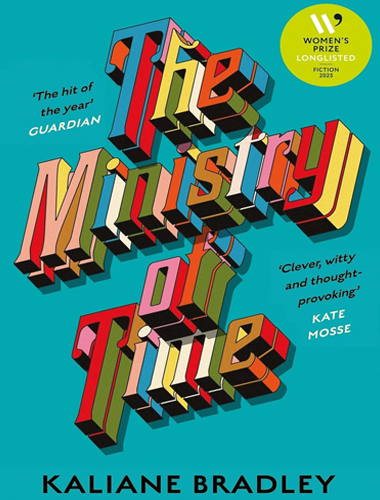
Pivoting on this concept, Bradley crafts a riveting and intellectually invigorating narrative that teeters on the precipice of time travel. Venturing into the realm of an intricate fusion of science and speculative fiction, blended with espionage-laden bureaucratic satire imbued with a hauntingly melancholic love story, the novel masterfully questions and philosophizes on the profound repercussions of extracting and teleporting historical figures from bygone eras into the near future. Cerebral and deeply evocative, this novel defies conventional storytelling, drawing readers into a world where past and present converge within a deeply philosophical narrative.
At its core, the story revolves around a covert British governmental agency orchestrating meticulously controlled experiments in time travel – an endeavor steeped in bureaucratic precision and control. The protagonist, a British-Cambodian civil servant known as ‘Bridge’, is entrusted with the formidable task of facilitating the acclimatization of Commander Graham Gore referred to as ‘Expat’ to the bewildering complexities of 21st-century existence following his extraction from his bygone epoch. A Victorian-era explorer and naval officer, Gore struggles to navigate the disorienting juxtaposition of antiquity and modernity of this unfamiliar world. Bradley’s storytelling seamlessly oscillates between the protagonist’s present-day reality and Gore’s antiquated perspective weaving a richly layered exploration of cultural dissonance.
The deftly crafted characters stand as one of the novel’s greatest strengths. The protagonist’s inner turmoil- torn between her unwavering sense of duty, the profound ethical dilemmas of time manipulation, and her burgeoning love for Gore- renders her a figure of immense emotional depth. Further intensifying her sense of dislocation is her dual heritage (British-Cambodian) which serves as a poignant reflection of the novel’s theme of being caught between different times.
Bradley imbues Commander Gore’s character with exquisite nuance, portraying him as a man lost in time – both literary and metaphorically. She masterfully captures his gradual acclimatization to contemporary life with a delicate balance of poignancy and restraint. Gore’s struggle to reconcile his rigid Victorian values with the intricate complexities of the present day leads to moments that are funny and deeply moving.
Is it justifiable to extract people from a bygone era and teleport them to the present? What are the profound moral implications of such an intervention? What becomes of their love if it stands the inexorable passage of time, or is it fated to unravel? Will their love story endure, or will Gore be consigned once more through the relentless currents of time travel? What destiny awaits them? Does a romance enmeshed in the complexities of time travel deserve a happy ending? If these questions captivate your curiosity, then this book is an essential read, offering a profound exploration of these dilemmas.
This novel is as intellectually stimulating as it’s beautifully rendered, especially considering it is a debut. It makes one contemplate the fluidity of time, how history is something we construct, and how fragile the connections to our own identities can be. It’s a profoundly evocative and haunting reflection on the inexorable passage of time and the unresolved ghosts we all carry within us.