
Melancholy is like an enticing, brooding requiem that slowly ensnares you in its wake. Its rhythm is a stealthy force infiltrating your space, senses, and essence, feeding off your emotions and thoughts, one spectral note at a time.
It’s a one-way ticket to an abyss – a constricted, suffocating void infested with impenetrable darkness, bereft of light or hope. A harrowing, sinking sensation that is stiflingly hot envelops its victim, inducing a claustrophobic dread with each shallow, laborious breath. The air is stale, dank, and oppressive, coiling like the inexorable jaws of death.
Involuntary are the feelings of entrapment and helplessness under such dire circumstances, for they manifest as an unwelcome summons to all the unaddressed, suppressed emotions that lie dormant – conveniently ignored by the individual and their loved ones. Lethal is its bite, for a portentous and impregnable pall of ominous silence descends upon the impaled victim, with the incentive to penetrate, infiltrate and strip one of their essence, identity, and behavioural traits. It’s an icy, spectral shadow of embrace, steeped in the gory crimson of impending doom, steadily encroaching upon every cell of its host, whispering in an eerie voice – lullaby of looming sleep and fatality.
Han Kang, masterfully explores the sensitive and often overlooked complexities pertaining to mental health, highlighting its repercussions when neglected and ignored – leading to major ramifications with detrimental eventualities that can easily be avoided with timely intervention. Many lives have succumbed to this desolate and pessimistic battle, and Han Kang weaves a dark, gloomy narrative of a woman, raised within the confines of a strong, rigid patriarchal family, where she became a perpetual scapegoat for her father’s atrocities from a very young age.
The narrative unfolds into three seamlessly interwoven segments, each set two years apart – explicitly tracing the trajectory of the protagonist, Yeong-hye. An ordinary woman of reticent and taciturn disposition, with average features and a modest profession, possessing nothing extraordinary to boast of, married to Mr Cheong, a mediocre uninspired employee with no grand ambitions, holding a stable job with minimal responsibilities, drifting through life solely for the sake of mundane survival but still wants to control and dominate.
The first part of the book unfolds with seemingly alarming instances, as witnessed and expressed by Mr Cheong.
A peculiar habit that Mr Cheong found strange in his wife was her aversion to wearing a bra. “Bras are restrictive and make me uncomfortable” used to be her response. These words emphasise the deeply embedded emotions lying dormant within her – sentiments that would eventually erupt like a volcano, symbolising her stance on not conforming to societal norms and conventions.
I had a dream….
Dreams of carnage, killing animals, blood and gore instil a sense of brooding fear, an all-consuming paranoia and anxiety that seeps insidiously into Yeong-hye’s veins, perpetually enshrouded in darkness, she finds herself trapped in relentless wakefulness, where sleep eludes her, surrendering to the inexorable pull of fate, irrevocably altering the course of her life. The putrefying effect of these nightmares wreaks havoc on her already withdrawn persona – she first abandons meat, becomes a strict vegetarian and eventually refuses to cook it. This escalation breeds discord with her husband and culminates in a humiliating confrontation with her father striking her twice in front of her husband, mother, sister and brother-in-law for disobeying his demand to eat meat. This moment highlights her father’s tyrannical, oppressive nature and the deeply entrenched misogyny that permeates her household.
Had these simmering issues been acknowledged early on and the men in her life held accountable for their actions – including her husband who ill-treated her and debased her existence to that of a mere caretaker, a cook, and a vessel for his sexual gratification, subjecting her to marital rape when she failed to comply – her fate might have been different. Perhaps then, she wouldn’t have been driven to the precipice of despair to the point where she tried to take her life by slashing her wrist with a knife.
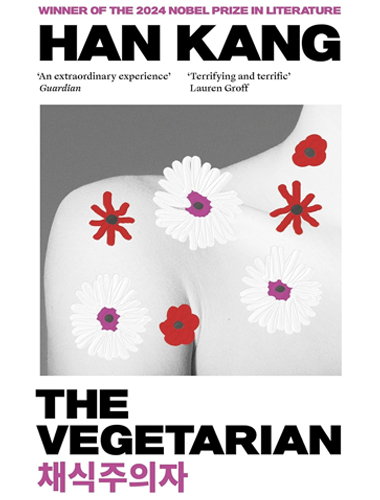
The second section of the book unfolds through the perspective of Yeong-hye’s brother-in-law, who silently and unnervingly finds her obsession with vegetarianism both peculiar and erotically enticing. Her oddities, her quiet defiance, and eccentricities appear to him strangely seductive, her madness an irresistible enigma. He finds himself lusting after her when, by chance, he learns that she bears a Mongolian mark on her bottom. As an artist, this revelation fuels his imagination, compelling him to sketch and paint human figures entwined with lush, vividly hued flowers – each body enveloped in blossoms, stretching and yearning towards the sun. He gets obsessed with this thought, culminating in an act of artistic and moral transgression – he paints Yeong-hye’s body with intricate, resplendent beautiful flowers, a prelude to the ultimate consummation of his illicit longing, as he engages in having s*x with her.
This section exposes the carnal obsession of a man who preys upon a mentally vulnerable woman – someone within his own family, and incapable of defending herself. It unflinchingly portrays a man whose warped psyche drives him to manipulate and violate her body for his gratification. This narrative starkly reflects the brutal reality of women being objectified and reduced to nothing more than a vessel of flesh and blood, existing solely to satiate male desire.
The third part of the book unveils Yeong-Hye’s final descent into the void – a harrowing ordeal marked by brutality and torment of being silently consumed by an abyss of unrelenting darkness. Trapped is she within the isolating confines of an asylum, ensnared in a vortex of solitude, where her only solace of warmth comes from the fleeting embrace of luminescent sunlight – a hope in her desolate existence. The final chapter unravels the profound, long-buried conversations that transpired between Yeong-hye and her older sister as seen through the latter’s perspective. It was always Yeong-hye who bore the full brunt of their father’s merciless wrath. Enduring blows silently, she absorbed every act of cruelty that reshaped the very core of her being. A life once brimming with potential and vitality drained away – squandered. But for what?
Here, the sister wrestles with tormenting questions – what if she or her mother had intervened, putting an end to the cruelty young Yeong-hye endured at the hands of their father? Could her sister have been spared the agony inflicted by those meant to protect her?
Why did no one take heed when Yeong-Hye suddenly decided to go vegetarian and her demeanour began to shift? Why were her haunting dreams dismissed, her silent cries for help left unaddressed? Why was she abandoned, left to navigate her suffering in solitude? Who bears the burden of blame? Their parents, who disowned her, unwilling to confront what they perceived as insanity? Her husband, who divorced her, simply because she refused to bend to his whims and desires? Who is truly responsible? A life reduced to ruin, sacrificed – but for what? As Yeong-hye’s sister stares at the brooding trees, she finds herself questioning the very nature of sanity and wonders – why no one cares…
I was captivated by this book and devoured it in a single sitting. If you revel in dark, unsettling narratives, and appreciate the writing styles of Kafka and Murakami, then this masterpiece is an absolute must-read. with its haunting prose and evocative storytelling, it’s a 4-star read, and I highly recommend it to all.
(Han Kang is the first Korean writer to win The Nobel Prize in Literature 2024.)
(She won the International Booker Prize for her novel The Vegetarian in 2016.)