
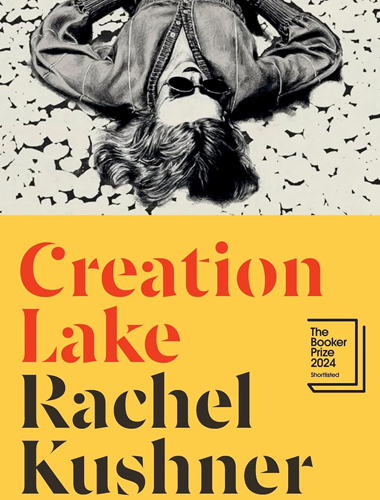
A narrative woven with rich and elaborate intricacies, imbued with layers of camouflage and secrecy, succulently infused with a veritable array of captivating characters, narrating a tale of espionage with a fusion of flavours, piquant enough to tickle the taste buds – each revelation a tantalising morsel that leaves readers craving for more. This is what Rachel Kushner’s book Creation Lake does to you.
The author conjures an adventurous fictional story of rivalry and high-stakes intrigue, seamlessly conveyed through the eyes of a strikingly beautiful and a cunning spy – entangled between forces of governance and an elite unit forming an intelligence agency, manipulating and manoeuvring through a world of shifting alliances and treacherous agendas, making Creation Lake a compelling read a testimony to Kushner’s masterful storytelling.
Meet Sadie Smith, the protagonist – a seasoned undercover agent on a mission to uncover a scheme that has veered dangerously off course – expensive equipment tied to this project has been deliberately sabotaged in the Guyenne valley – a group known as Le Moulin, who is executing a devious plan: to siphon the region’s ground water into massive, man-made “mega basins” with the aim of undermining the local agricultural industry for personal gain.
Sadie’s current assignment, given by her superiors, is to infiltrate this insular community by establishing a connection with Pascal, the influential head of the Moulinards. With a clear objective in mind – assigned is she with a task to craft a situation by skillfully manipulating a vulnerable member of the group, by enticing and encouraging them to take a rash action that could trigger a public incident – the motive, to prompt a scandal that would lead to the arrest of Le Moulin’s leadership.
Pascal and the entire Le Moulin community stem from the vision of their enigmatic, elderly guru, Bruno Lacombe. Having sequestered himself in isolation of caves for more than twelve years, Bruno lives as a recluse in the depths of unbroken darkness, forsaking all physical human contact and communicating solely with Pascal via email. His reflections, shaped by this life of solitude, have sparked a profound journey of self-exploration, leading him to revere the Neanderthals – whom he regards as possessing greater intelligence, courage, mathematical skill, and artistic refinement than Homo sapiens, the species that ultimately overtook them.
In the profound stillness of his shadowed cavernous refuge, Bruno finds himself attuned to the most delicate shifts in energy, as if tracing the faint breaths of ancient spirits. He senses the lingering presence of Neanderthal “lost souls,” weaving through the darkness like whispers from a time forgotten – an almost mystical communion. This solitude becomes his teacher, and the hallucinatory visions brought on by absolute darkness are not mere mirages to him, but portals – entrances into the minds of those primordial beings who walked before us.
At first, Sadie is skeptical, wary of Bruno’s intense worldview. Yet, something in his reverence for this primal wisdom stirs her, an ancestral pulse that she cannot ignore. She becomes captivated by his conviction that strength and resilience – qualities that may have faded in modern life – still linger in the echoes of these ancient souls, waiting like buried embers, quietly calling out for rediscovery.
Can Bruno’s philosophy of a commune devoid of exploitation and private ownership truly harmonize with human nature? Sadie’s curiosity is piqued as she contemplates whether humanity possesses the capacity to grasp the complex depths of its own unfathomable impulses. She wonders, does the commune centre genuinely embody Bruno’s vision of equality and unity, or is it, in truth, rife with the very exploitation he condemns? Will Sadie fulfill her mission’s elusive objectives? And what lies ahead for her life in the aftermath?
Bruno believes that self-interest and survival instincts are ingrained in Homo sapiens – traits that may have sealed the Neanderthals’ fate. But is it this innate self-centeredness that defines us, or have we always carried both the seeds of empathy and egoism, woven inseparably within?
If these questions ignite your curiosity, then this book is a journey you won’t want to miss. Reading it was an experience – though not without its flaws. Certain passages felt overly drawn-out, moments where a touch of precise editing could have sharpened the narrative. However, for those who appreciate espionage fiction, sophisticated prose, and subtle historical undercurrents, this novel offers a world to delve into, where every page feels like a step deeper into its secrets.